
Stopping the invasion – smuggling of live ants on the radar of Chinese authorities
Invertebrates are rarely the focus of wildlife trade research. Insects remain overlooked in both conservation and anti-trafficking efforts, despite their immense ecological importance and invasive potential. But international trafficking in insects, especially ants, is rampant. In April 2026, news agencies around the world published a story of a Chinese ant smuggler arrested in Nairobi airport with 2,200 live ants, mostly giant African harvester ant (Messor cephalotes), a species popular with hobbyists worldwide.
Ant keeping has become very popular in China. A 2023 study that looked at on-line trade in ants in China, identified more than 200 species on sale. At the SVIS Initiative we decided to analyze the seizures of ants made by Chinese customs. We scraped the social media and news reports for reports and posts on ant smuggling, identifying 73 cases of live ant seizures going back to 2015. The cases involved the total of 40,069 ants comprising 54 species and 32 genera.
Key findings: The number of ants, as well as the number of species, smuggled into China increased sharply after the Covid-19 pandemic, but has since dropped off markedly. Concealment inside goods shipped to China was the preferred method of ant trafficking. The Greater Bay Area, and especially Shenzhen, are the main point of entry. Seized ants belong to both rarer and expensive, as well commonly kept, cheaply-sold species. The seizures included both captive-bred species bought abroad, and also wild-caught ants, caught in and shipped from countries of origin. Chinese authorities are aware of the risk of invasive ant species entering China that such trade represents.
Boom over?
The first recorded seizure was in 2015 – almost a thousand ants seized in Beijing with no species specified, but no seizures were reported for the next three years (Fig. 1).

During the Covid-19 pandemic, when sending parcels into China from abroad was restricted, the number of seizures was low, but went up markedly once the Covid-19 restrictions were lifted at the end of 2022, with seizures peaking at 22 in 2024. There were also corresponding increases in the number of species smuggled – peaking at 16 in 2024, the number of ants – with the peak of over 16,000 in 2023, and the number of cities where seizures were made – 13 in 2024. A sharp drop-off in seizures, species and ant numbers followed in 2025 and 2026, suggesting that the ant boom in China may have passed. However, it may also be a result of the customs making fewer public admissions of ant smuggling, potentially to avoid the kind of negative publicity that followed the arrest of Chinese ant smuggler in Kenya.
Points of entry
Seizures of live ants were made in 22 different cities in China (Fig. 2). Shenzhen had the most seizures (16) followed by Guangzhou (6), Qingdao and Changsha (5), and Shanghai (4).

The Greater Bay Area and Guangdong Province appear to be the center of ant smuggling, accounting for 26 out of 73 cases, 24,381 out of 40,069 ants, and the top three seizures 7,507, 5,000, and 3,882 ants respectively (Fig. 3.). The largest seizure was in the city of Jiangmen with ants concealed in a shipment of clothes.
Shenzhen alone accounted for 14,594 (36%) of the ants seized (Fig. 3), and was also where the second-largest seizure was made – 5,000 Asian weaver ants (Oecophylla smaragdina), in March 2023. The seizure with the most species was also made in Shenzhen – in 2022 a shipment of gaming sets was found to contain containers with ants of 11 species (Fig. 4).


The provenance of ants was only mentioned in 6 reports, with the shipments arriving from Germany, Australia, Indonesia, Hong Kong and Thailand. Hong Kong is likely to be a major transfer destination. In the three cases involving Hong Kong, the ants were brought in by travellers crossing into Shenzhen in Mainland China. In one such case, plastic tubes with ants were concealed in jars of milk formula. However, carrying ants on a person or in the luggage was not the main method of smuggling. In more than 70% of the cases, the ants were hidden in parcels shipped to China. On their social media channels, China Customs posted videos of officers extracting tubes with live ants from toy cars, cookie boxes, teddy bears and even a Pikachu.
Species
It was difficult to estimate the number of ants of individual species. Many shipments contained multiple species and in almost all such cases the report provided the total number of ants and the list of species but without the contribution of each.
For example, when the shipment of the record 11 species was intercepted in Shenzhen (Messor wasmanni, M. capitatus, Gesomyrmex howardi, Stigmatomma rubiginoum, Ooceraea biroi, Myrmecocystus mexicanus, M. mimicus, Camponotus turkestanicus, C. sanctus and Cataglyphis pallida), only the total number of ants – 520 was given.
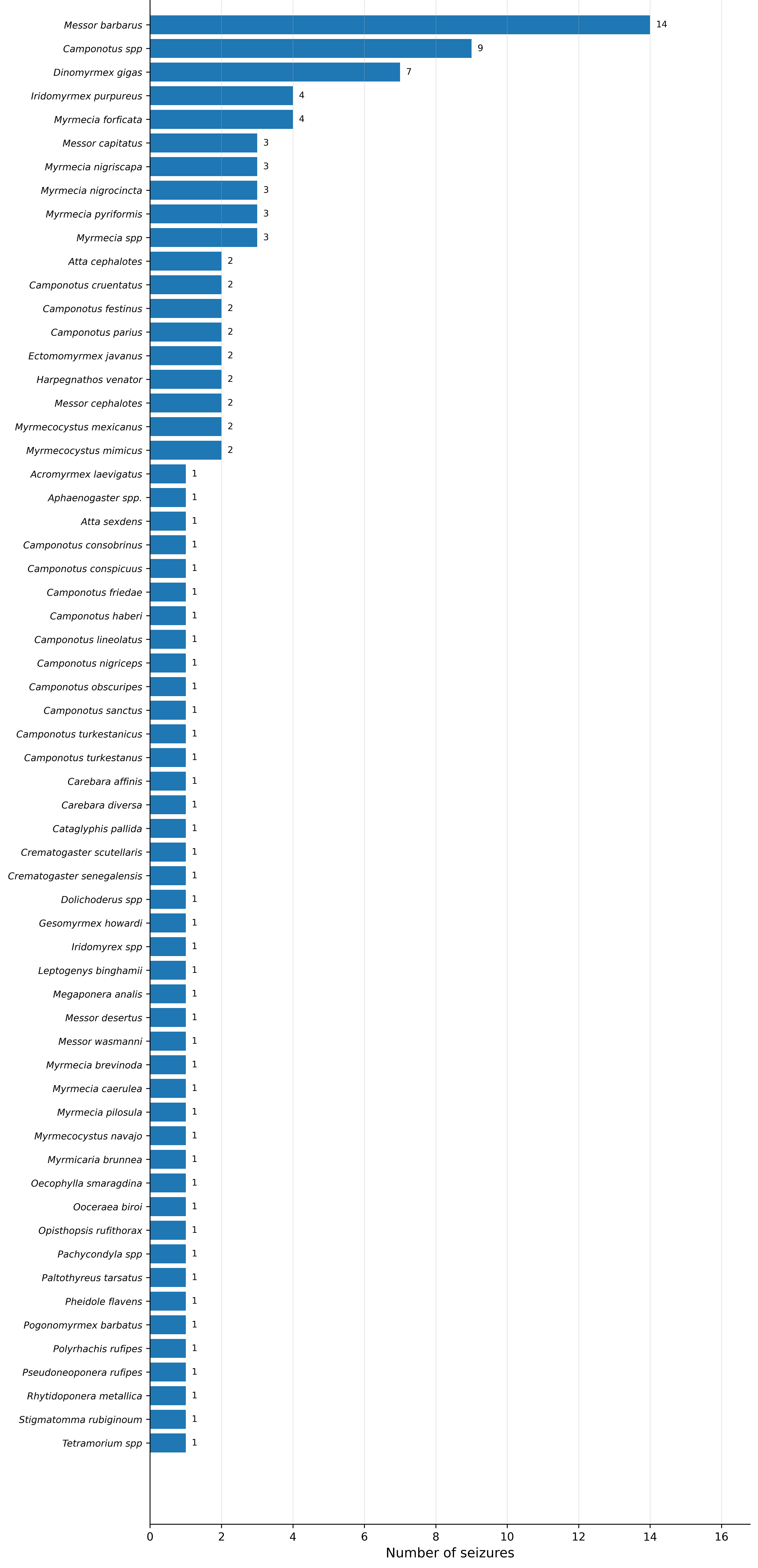
For this reason, we estimated the prevalence of species and genera via their appearance in seizures. (Figs. 5 & 6). Messor barbarus was the most common species, present in 14 out of 73 seizures. Dinomyrmex gigas was present in 7, and Iridomyrex purpurus and Myrmecia forficata in 4. The most commonly trafficked genera were Camponotus – 25 seizures, Messor (21), Myrmecia (19), Dinomyrmex (7), and Myrmecocystus (5).
These taxa are popular amongst hobbyists world-wide for the their size (Dinomyrmex gigas), charismatic aggressive behaviours (Myrmecia), striking colony formations (Myrmecocystus), and ease of keeping and suitability for beginner hobbyists (Messor).

Prices
We analyzed the prices for the seized species on the online trading platform Taobao. The most expensive species were honey ant (Myrmecocystus mexicanus), false honeypot ant (M. mimicus), and Navajo honeypot ant (M. navaho) both valued at 3,500 – 10,000 yuan ($500 –1,500) for a queen and a number of workers. Very prized were also Australian bulldog ants of the genus Myrmecia. A queen of M. forficata costs 900 yuan ($130) and must be pre-ordered. A single queen of M. brevinoda, giant bulldog ant, costs 1,800 yuan ($270) (Fig. 7).

A queen and 20 workers of European harvester ant (Messor barbarus) are sold for as little as 40 yuan ($6) on-line. Present in the record 14 seizures, this species, however, may be overrepresented due to misidentification by the customs. Another commonly smuggled Messor species – M. capitatus, is worth more than ten times than M. barbarus.
Ants are usually sold as a package of a queen and a number of workers, from around 5 to 50. From some of the videos posted by China Customs it is possible to see that the smuggled shipments had both queens and workers, but it was not possible to estimate how many there were. Using a rough estimate of 50 workers to one queen, we extrapolate that the shipment of over 600 Myrmecocystus mexicanus would have around 12 queens. This would make the shipment worth over 120,000 yuan ($18,000), an equivalent of a middle-class annual wage in major Chinese cities, and well above the median national income.
Wild or captive bred?
It appears that some of the shipments seized contained wild caught ants. Most multiple-species shipments contained species from different continents, suggesting that they were purchased from breeders abroad and sent to China. The seizures that we think were of wild-caught ants had species from a single geographic location.
Most of such seizures contained Australian species. Moreover, one of the shipments was identified as coming from Australia – in 2020, 7 ants of the species Myrmecia forficata, M. nigrocincta and M. nigriscapa, were mailed to Changsha. (Another species in the shipment was Camponotus conspicuus, an American species, likely a misidentification.) Myrmecia, commonly known as bulldog ants, are high-value species, and a queen and several workers cost up to 900 yuan. Another shipment, also mailed to Changsha (provenance not specified) in 2025, contained 104 ants of Australian species M. nigrocincta, M. nigriscapa, Camponotus consobrinus and Iridiomyrex purpurus. Another multiple-species seizure of Australian species (11 queens of 6 species) was made in Shenzhen in 2025, arriving from Hong Kong.
There is also evidence that African species caught in the wild are being trafficked. Seventy-one ants of three African species Paltothyreus tarsatus, Crematogaster senegalensis and Camponotus lineolatus were intercepted in Guangzhou. The video showed that the ants were hidden in a gourd, likely a souvenir bought in Africa, sent via DHL.
Another multiple-species shipment likely to be of wild caught ants consisted of high-value species native to Southern US and Mexico – honey pot ants Myrmecocystus mexicanus, M. mimicus and M. navaho. Moreover, the same shipment contained what was identified only as leaf cutter ants (possibly Atta spp.), which are also native to the Americas. This shipment of 417 ants was intercepted in Qingdao, hidden in a jigsaw puzzle depicting the Louvre, the provenance was not stated.
No ant species are listed by CITES, and exotic ants are traded and advertised openly by hobbyists in China, as they are in other countries. Ant smugglers, however, are breaking Chinese law by bringing in live organisms and potential invasive species. The social media posts of China Customs remind the readers of the illegality of brining non-native species into China, and the economic and environmental risks posed by invasive ants.
Ants are foundational species that play essential ecological roles, and conservationists have recently called for CITES listing of all ant species in order to curb trafficking. Climate change now allows tropical and subtropical species to extend their ranges into temperate ecosystems. This increases the risk of escaped or released ants becoming highly damaging invasive species in regions where they could not previously establish. The number and the content of posts on ant smuggling by China Customs shows that the Chinese authorities consider it a serious biosecurity problem.


Comments